
Contents
Staking and crypto lending can both increase your token balance, but they pay you for different activities. In proof-of-stake staking, assets support a blockchain's consensus process. In lending, assets provide credit to borrowers, directly through a protocol or through a company. That difference matters more than whether an app calls the product “Earn.”
Before comparing rates, answer four questions: What produces the return? Who controls the assets? How could you lose principal? What must happen before you can withdraw? A higher displayed yield answers none of them.
Ethereum and Aave v3 provide concrete examples below. They illustrate particular mechanisms, not rules for every blockchain or a recommendation to use either service. Ethereum staking, Aave v3 overview
Staking vs lending at a glance
Pooled staking is a way to participate in staking, not a separate source of returns. It appears separately here because an intermediary changes what you need to check.
| What to compare | Direct consensus staking | Pooled consensus staking | Centralized crypto lending | Onchain lending, using Aave v3 as an example |
|---|---|---|---|---|
| Underlying activity | A validator participates in blockchain consensus | Pool operators run validators using pooled assets | A company lends or otherwise deploys customer assets under its terms | Supplied liquidity supports collateralized borrowing |
| Source of return | Protocol participation rewards; other components depend on the chain | Validator rewards allocated under the pool's rules, after its fees | Interest promised under the account agreement, supported by the company's activities | Borrower interest, less the protocol reserve factor; incentives may be separate |
| Your connection to the assets | Your own validator and withdrawal credentials in a solo Ethereum setup | A pool, service account or token claim, depending on the design | An account and contractual claim against the provider | An interest-bearing aToken position governed by smart contracts |
| Distinctive loss channels | Validator penalties, slashing and operational mistakes | Validator risks plus relevant contract, operator, governance or custody risks | Borrower defaults, provider failure, misuse of assets or inadequate liquidity | Contract bugs, oracle failures, collateral shortfalls and network risks |
| Exit conditions | Chain-specific exit and withdrawal rules | Pool rules plus the underlying staking exit; a transferable receipt may offer a separate sale route | Account terms and the provider's ability to honor withdrawals | Available unborrowed liquidity and collateral requirements for any active borrowing |
Token-price risk applies across these routes. The table describes structures, not a safety ranking or the terms of a particular centralized account. Ethereum staking options, pooled staking, Aave v3, Aave risks, SEC staff bulletin on crypto interest accounts
First, identify what the product actually does
For Ethereum, staking means committing ETH to activate a validator. Validators propose blocks and attest to the chain's state. Correct participation earns rewards; being offline can cause missed rewards and penalties, while certain provable violations can trigger slashing. Ordinary downtime and slashable misconduct are not the same event. Ethereum staking mechanics
Lending is different. You make assets available for someone else to borrow. In Aave v3, borrowers pay interest into a pool, and suppliers receive interest after the reserve factor is applied. The rate changes with utilization rather than being a universal fixed return. Aave v3 interest rates
The word “staking” is not enough to identify consensus participation. Aave's Umbrella, for example, uses staked assets to cover specified lending-pool deficits. Participants accept potential slashing in return for rewards. That is backstop capital for a lending protocol, not ETH validating Ethereum. Aave Umbrella
If a product description does not make the underlying activity clear, ask what your assets do after deposit and what event could reduce your balance. Do not fill the gap by assuming a familiar label means a familiar risk.
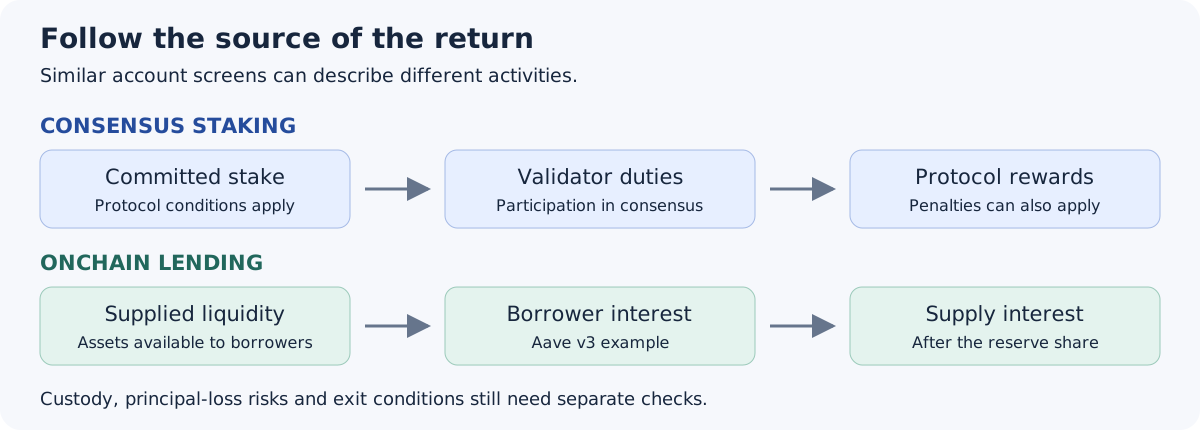
The mechanism in plain text:
- Consensus staking: committed stake supports validator duties; the chain allocates participation rewards under its rules.
- Onchain lending: suppliers make liquidity available; borrowers pay interest; the protocol allocates supply interest after its reserve share.
A custodial service can sit between you and either activity. Custody and return source are separate questions.
Who controls the assets, and what do you hold?
Direct staking leaves operational work with you
In a solo Ethereum setup, you run the validator and retain your keys. That removes a staking company's custody from the arrangement, but it does not remove software, key-management or validator-operation risk. Assets committed to staking are not the same as an unrestricted wallet balance. Protocol rules still govern the exit. Ethereum staking options
Delegating validator operation changes the arrangement again. Check who holds signing credentials, who controls withdrawal credentials and which actions you can perform without the operator. “Someone runs the validator for me” and “someone holds all my assets for me” need not mean the same thing.
A pool adds another set of rules
A staking pool combines contributions and uses operators to run validators. Some pools issue a liquid staking token; others use a nontransferable account balance or an offchain arrangement. Read how rewards, fees and losses are allocated, and what rights your balance or receipt actually gives you. Ethereum pooled-staking documentation
If you receive a liquid staking token, selling it to another buyer is not the same as redeeming the underlying stake. The sale depends on the available market price and liquidity. Redemption follows the staking protocol's process. A tradable receipt does not make the underlying stake instantly withdrawable.
A lending account depends on the provider's obligations
With a centralized lending product, inspect the agreement rather than assuming that a displayed crypto balance means assets remain segregated in your own wallet. The provider's investment or lending activities, financial condition and ability to meet withdrawals matter. The SEC staff's crypto interest-account bulletin describes company failure, defaults and illiquidity as material risks. Crypto interest-account risks
Ask who owes you repayment, whether the assets can be lent onward, and what the agreement says about withdrawals and a provider failure. Those answers are product-specific. Do not assume a crypto yield account has the protections of an insured bank deposit.
Onchain supply replaces some intermediaries, not every dependency
Supplying to Aave v3 produces aTokens, which represent the supply position and accrue interest. The underlying assets are managed by protocol contracts, rather than sitting unused in your wallet. Redeeming the aTokens depends on the protocol's conditions. Holding your wallet keys does not give you unconditional access to assets currently borrowed from the pool. Aave v3 supply and withdrawals
Separate the loss mechanisms
A useful comparison names what can go wrong instead of placing everything under “crypto risk.”
- Token-price loss. More tokens can still be worth less in your chosen currency.
- Validator loss. Staking can expose you to protocol penalties or slashing. A pool's rules determine how validator losses reach participants.
- Counterparty loss. A centralized provider or its borrowers may fail to meet their obligations.
- Contract and infrastructure loss. Onchain lending can be affected by bugs, price-oracle failures, collateral shortfalls or problems with the network or bridge used.
- Exit risk. You may be unable to access assets when needed, even before a final loss is known.
Aave's risk documentation explicitly identifies contract, oracle, collateral, and network or bridge risks. Audits and collateral requirements help manage risks; they do not make losses impossible. Aave risk documentation
Supplying is not the same as borrowing against your supply
In Aave v3, supplying an asset without borrowing does not create a debt position that can be liquidated merely because that asset's price falls. That does not eliminate the supply position's market or protocol risks.
If you also use supplied assets as collateral and borrow, you add a different exposure. A falling collateral value, rising debt value or accrued interest can weaken the position's health factor. Aave v3 makes a borrow position eligible for liquidation when its health factor falls below 1. Withdrawing collateral can also be restricted if it would leave the borrowing position insufficiently collateralized. Aave v3 borrowing and liquidation
Keep these roles separate when reading a comparison: a supplier's exposure to pool losses is not the same as a borrower's collateral being liquidated.
Compare returns in the same units
A headline percentage is useful only after you know what it measures. Check:
- The asset deposited and the asset used to pay rewards or interest.
- Whether the displayed rate is variable, fixed for a stated term or merely historical.
- Whether fees have already been deducted.
- Whether compounding is assumed and whether it happens automatically.
- Whether extra incentive tokens are included, and how their value is measured.
- Entry, exit, network, conversion and validator-operation costs relevant to your route.
For Aave v3, utilization influences the interest rate; a current annualized display is not a promise that the same rate will persist. For staking, reward allocation, validator performance and service fees affect what reaches you. Comparing a gross staking figure with a net lending figure is not a like-for-like comparison. Aave v3, Ethereum pooled staking
Hypothetical example: a larger token balance, a smaller value
Suppose you start with 100 tokens worth $10 each. Over a hypothetical period, you receive 3 tokens after the product's fees, with no deposits, withdrawals or principal deductions. By the end, the token price is $8.
| Measure | Calculation | Result |
|---|---|---|
| Starting value | 100 × $10 | $1,000 |
| Ending token balance | 100 + 3 | 103 tokens |
| Ending value | 103 × $8 | $824 |
| Change in value | $824 − $1,000 | −$176, or −17.6% |
| Holding the original tokens | 100 × $8 | $800 |
You have 3% more tokens and $24 more than simply holding the original 100 at the same ending price, but your value is still down 17.6%. This is invented arithmetic, not a quoted rate, annual return or forecast. It excludes taxes and any separate entry, exit, network or conversion costs. It also assumes the full ending balance is recoverable. If withdrawals are blocked, an account display alone does not establish what you can receive.
Compare the exit before the yield
Ask what “withdraw” means for the exact product you are considering.
For direct staking, check the chain's validator-exit and withdrawal process. For pooled staking, add the pool's request, processing and redemption rules. If a receipt token can be sold, ask whether the quoted sale proceeds cover the amount you want to exit, not just whether a trading pair exists. Ethereum staking pools
For centralized lending, check the stated term, notice period, withdrawal conditions and the provider's powers to suspend withdrawals. A “flexible” label is not proof of uninterrupted access. The SEC staff has documented cases in which financially distressed crypto entities halted customer withdrawals; that is a warning about a possible failure mode, not a claim about every provider. SEC staff investor alert
For Aave v3, available unborrowed liquidity matters. If much of the relevant asset has been borrowed, the amount immediately redeemable may be limited. A supplied position that also supports your own borrowing faces a second constraint: collateral requirements. A high displayed supply rate does not override either restriction. Aave v3 withdrawal conditions
A practical decision checklist
Before evaluating a specific offering, write down these six answers:
- Mechanism: consensus validation, lending, backstop capital or a combination?
- Claim and control: wallet-held assets, a receipt token, a contract position or a provider account? Who can move or restrict them?
- Return: which asset is paid, what funds the payment, and what is left after fees and relevant costs?
- Loss: which events can reduce principal, and who bears those losses?
- Exit: what steps, liquidity conditions or delays apply to the amount you expect to withdraw?
- Access: is the exact product offered to your customer category where you live, under current terms and rules?
An accessible website does not settle the last question. Check the provider's eligibility information and the relevant regulator before depositing. This guide does not determine legal access or tax treatment for any country.
If you cannot answer the first five questions, comparing the rate is premature. If you need the assets available on a particular date, a return comparison is incomplete until you understand the exit conditions.
Frequently asked questions
Is staking always safer than lending?
No. The answer depends on the chain, operator, custody arrangement and contracts involved. Consensus staking and lending have different loss mechanisms; adding a provider or another protocol changes the comparison. A label alone cannot establish a safety ranking.
Is lending interest fixed?
Not necessarily. Aave v3 uses utilization-based variable rates. A centralized product may offer a stated term or rate under its own agreement, but that says nothing by itself about the provider's ability to pay.
Can I lose money while earning rewards?
Yes. A decline in token value can exceed the value of rewards, as the example shows. Penalties, provider failure and protocol losses are separate ways principal can be affected.
Is liquid staking another name for lending?
No. A liquid staking token generally represents a claim linked to a staking arrangement. Using that token in a lending protocol would be an additional activity, with additional conditions and risks.
Keep learning
Explore educational guides. These links do not open trading markets.
Sources
- Ethereum: staking mechanisms and participation options
- Ethereum: pooled staking, receipt tokens and exits
- Aave v3: supply, borrowing, interest and withdrawals
- Aave: protocol risks
- Aave Umbrella: backstop staking and slashing
- SEC staff: Crypto Asset Interest-bearing Accounts, February 14, 2022
- SEC staff: Exercise Caution with Crypto Asset Securities, March 23, 2023
HypaForecast publishes educational guides and operates a prediction market. This comparison is not a staking or lending offer.
Share this guide