
Contents
- Staking and liquid staking are not opposite activities
- Two exit routes: sell the token or redeem the stake
- Token balance, backing and market price are different numbers
- Compare net outcomes, not the largest advertised yield
- Liquid staking adds choices and dependencies
- Which arrangement fits the decision you are making?
- Frequently asked questions
- The bottom line
- Sources
Liquid staking gives you a transferable token linked to a staking position. It does not make the underlying stake instantly withdrawable. If you want to leave, you may be able to sell that token to someone else, or request redemption through the protocol. Those routes can produce different amounts and take different lengths of time. Ethereum's pooled-staking guide
Start with one practical question: do you need the underlying asset back, or would selling a token claim meet your needs? Then check who controls the position, what your token represents and what each exit actually costs.
This guide uses Ethereum and Lido's stETH and wstETH as examples. Other networks and services have different rules; these examples are not product recommendations.
Staking and liquid staking are not opposite activities
Staking supports a proof-of-stake blockchain. On Ethereum, validators put ETH at stake and earn rewards for performing network duties correctly. Missed duties can reduce rewards and incur penalties; certain conflicting signatures can lead to slashing, a more serious loss of stake. A reward rate is not a guaranteed return. Ethereum staking
Liquid staking builds a token layer around that activity. The token holder has a claim governed by the staking service or its contracts, rather than a personal validator balance they can directly spend. The underlying staking still has to happen.
Pooling and liquidity describe different features. Pooling combines participants' funds. Liquidity concerns whether you can transfer or sell the claim. A pool does not automatically issue a liquid staking token, and a balance displayed in a provider's app does not prove that you hold a transferable token. Ethereum's explanation of staking pools
Compare the arrangement you would actually use
| Arrangement | Who operates the validator? | What do you hold? | How do you leave? | What else matters? |
|---|---|---|---|---|
| Solo staking on Ethereum | You | Your validator position, with your withdrawal credentials | Follow Ethereum's withdrawal and exit rules | Key security, hardware, uptime and protocol penalties |
| A pool without a transferable LST | The pool's operators | A claim or account balance under the pool's rules | Use the pool's withdrawal process | Custody, contractual or smart-contract rules, fees and operator performance |
| Liquid staking | The protocol's participating operators | An LST representing a claim connected to pooled staking | Sell the LST, or use the protocol's redemption process | Contracts, accounting, governance, operators and market liquidity |
This is a comparison of arrangements, not a security ranking. Ethereum solo staking requires at least 32 ETH to activate a validator and puts operation and key management in your hands. Pools can let participants contribute smaller amounts without running hardware. Hiring a validator operator is another arrangement: outsourcing operation does not by itself create a liquid token. Ethereum's solo-staking guide
Two exit routes: sell the token or redeem the stake
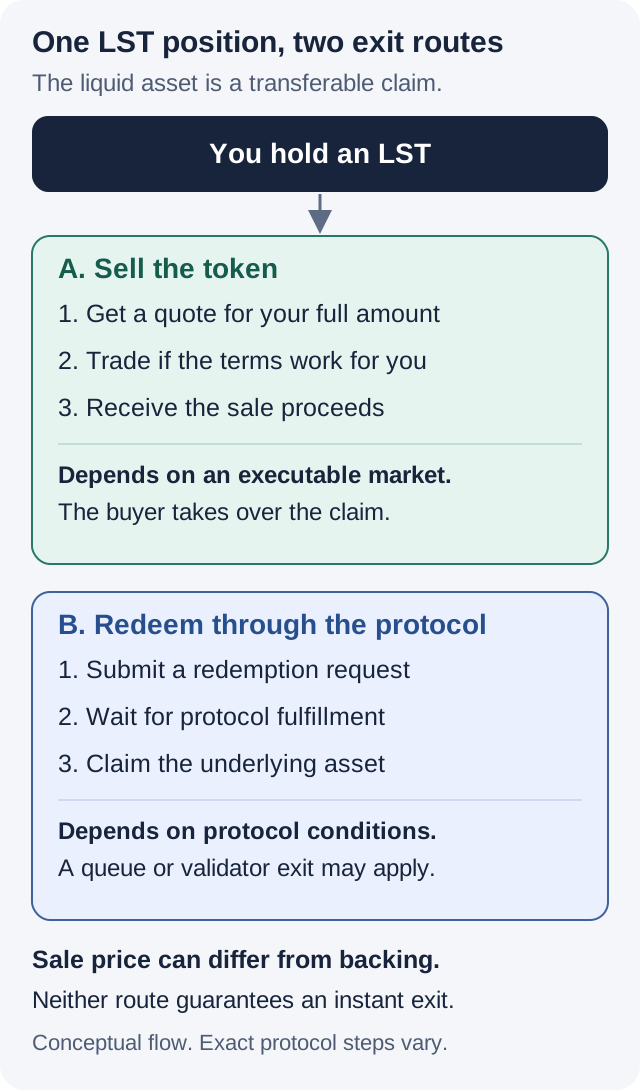
Selling transfers the token claim to a buyer. Redemption follows the protocol's process for returning the underlying asset. The diagram is conceptual: exact steps and waiting conditions depend on the implementation.
Route 1: sell your LST
A sale can let you leave without waiting for the underlying validator to exit. You receive what the market will pay for your token, not necessarily the amount of ETH represented by its accounting balance. Lido distinguishes trading stETH on a secondary market from entering its withdrawal queue. Lido's withdrawal overview
For a useful comparison, inspect a quote for the whole amount you want to sell. A displayed price for a small trade may not describe the proceeds of a larger one. Check:
- The asset and network you will receive, such as ETH rather than another token.
- The quoted output after trading fees and price impact, plus gas or other costs not included.
- The minimum output or slippage setting and whether the quote can change before execution.
- Any exchange custody, trading suspension or withdrawal requirements that stand between a sale and usable funds.
An LST being transferable does not ensure that a buyer or pool will absorb your order at a price you accept. A quick sale, when available, changes who holds the claim; it does not accelerate Ethereum's validator exit process.
Route 2: redeem through the protocol
Redemption uses the protocol's rules instead of finding a buyer for the LST. Available unstaked funds may satisfy a request; otherwise, underlying validators may need to exit. Queue demand, protocol processing and network conditions can affect the wait. Lido's documented process uses available ETH in its buffer and validator exits where needed. Lido's withdrawal process
In Lido's withdrawal-queue contract, the main stages are:
- Submit a withdrawal request and lock the relevant tokens.
- Wait for finalization, when the protocol determines and reserves the claimable ETH.
- Claim that ETH after the request becomes available.
A withdrawal NFT represents the queued request. It is not the same asset as the stETH you submitted. Lido also specifies that queued tokens do not earn rewards for you during the wait, while losses can still affect the eventual amount. Its contract documentation allows finalization below the submitted stETH amount under sufficiently severe loss conditions. Neither the original balance nor an estimated wait is an unconditional payout promise. Lido withdrawal-queue contract
Do not copy these precise steps onto every LST. Ethereum's own withdrawal documentation directs pool participants to their provider's process, because it can differ from a solo validator's withdrawal. Ethereum staking withdrawals
Token balance, backing and market price are different numbers
An LST can account for staking rewards in more than one way. Two common designs are:
- Rebasing: the number of tokens in your balance changes as the protocol accounts for rewards or losses. Lido's stETH uses this approach. Its reports reflect validator rewards and penalties, so an increasing balance is not an unconditional promise. Lido rewards and penalties
- Exchange-rate or value-accruing: your token count does not increase just because rewards accrue. Instead, the amount represented by each token changes. Lido's wstETH wraps stETH in this form: its balance does not rebase, while the amount of stETH represented by each wstETH changes. wstETH contract documentation
Neither token count nor exchange rate is automatically a market quote. In particular, comparing one wstETH with one ETH ignores the wrapper's conversion rate. Unwrapping wstETH returns stETH; it does not itself withdraw ETH from validators. How the wstETH wrapper works
For either design, separate three questions: how many tokens do you own, what amount do the protocol's rules currently associate with them, and what would a buyer pay now? A changing ETH price adds another question if you measure your outcome in dollars or another currency.
Worked example: a token above 1 ETH can still trade at a discount
These numbers are invented to explain the comparison. They are not a quote, an APY, a current exchange rate or a prediction for any named token. Assume a fictional exchange-rate LST, no balance change during the example, and a sale quote that already includes trading fees and price impact but excludes gas.
| Item | Hypothetical amount |
|---|---|
| Your balance | 8 LST |
| Protocol accounting amount per token | 1.10 ETH |
| Accounting amount for your balance | 8 × 1.10 = 8.80 ETH |
| Executable sale output per token | 1.078 ETH |
| Sale proceeds before gas | 8 × 1.078 = 8.624 ETH |
| Gas paid separately | 0.004 ETH |
| Net proceeds after gas | 8.620 ETH |
The sale quote is 2% below the accounting amount: 1.078 ÷ 1.10 − 1 = −0.02. It is still above 1 ETH per token. The relevant comparison is with the token's represented amount, not a presumed one-token-to-one-ETH peg.
The 8.80 ETH accounting figure is not a claim that you can redeem 8.80 ETH immediately or without cost. Redemption could involve a wait, fees, losses or other conditions. The sale is 0.18 ETH below that accounting figure after the assumed gas cost; this is not a guaranteed gain from choosing redemption instead. The example also excludes tax and changes in ETH's price.
Compare net outcomes, not the largest advertised yield
Liquid staking does not create a second stream of blockchain rewards merely by issuing a token. In the Lido example, the token's rewards reflect validator activity, including consensus rewards and variable execution-layer income. Performance and network conditions affect the outcome. Lido's reward mechanics
Use the same time period and asset when comparing two offers. Ask whether the displayed yield is before or after the service's fee, whether it assumes compounding, and whether a temporary incentive is included. Then account for costs outside that figure:
- Solo staking can involve equipment, connectivity and maintenance.
- A managed arrangement can charge service or protocol fees.
- Entering, wrapping, transferring, selling or claiming can create transaction costs.
- A discounted sale can reduce your exit proceeds even after rewards have accumulated.
Avoid adding a charge twice if a quoted rate or output already includes it. And keep staking yield separate from the underlying asset's market return: earning additional units does not guarantee that their cash value rises.
Liquid staking adds choices and dependencies
Running your own validator removes some intermediaries, but leaves you responsible for software, keys and uptime. On Ethereum, ordinary downtime penalties and slashing are distinct; a validator merely being offline is not automatically a slashing event. Ethereum's operational considerations
With a liquid staking arrangement, investigate the specific implementation:
- Contracts and accounting: what holds the assets, updates balances and controls redemption? Bugs or incorrect accounting can affect the claim.
- Operators and loss allocation: who performs validation, and how are penalties or slashing losses passed on to holders?
- Governance and upgrades: who can change fees or contract behavior, and what protections or exit options apply?
- Market liquidity: if redemption is delayed, could you sell your intended amount, and at what discount?
Lido's own risk disclosure identifies software, oracle and governance risks alongside staking penalties. Those categories are reasons to examine a deployment, not proof that every LST has the same controls or failure modes. Lido's known risks
Using the token elsewhere is an additional decision
Holding an LST does not require borrowing against it, supplying it to a trading pool or moving it across a bridge. Each extra use introduces another set of rules. For example, borrowing against collateral makes the loan's liquidation conditions relevant, even if the underlying staking continues normally. Lido warns specifically about complex and leveraged positions involving its tokens. Lido's DeFi risk discussion
Restaking is separate too: it can commit staked assets to additional services with additional penalty conditions. It is not a requirement for ordinary liquid staking. An offer with extra yield needs an explanation of the extra activity and exposure. Ethereum's discussion of restaking in pooled products
Which arrangement fits the decision you are making?
Use your requirements to narrow the comparison, rather than choosing a label first.
- You want to operate a validator and control its setup. Examine solo staking requirements, your ability to maintain it and the protocol's withdrawal rules.
- You want staking exposure without running hardware. Compare the actual pooled or managed services, including custody, fee terms and how losses reach you. A liquid token is optional, not proof of a better service.
- You want the option to sell before redemption completes. Check an LST's real trading markets and redemption fallback. Decide whether a variable sale price meets your liquidity need.
- You need a predictable amount available on a fixed date. Neither a market sale nor a queued redemption should be treated as a guaranteed cash-equivalent withdrawal.
Before committing funds, be able to explain what you will hold, who can change its rules, what could reduce its value, and both the ordinary and stressed exit routes. Check the service's current terms and whether it is available to you; this comparison does not establish legal or tax treatment in your location.
Frequently asked questions
Is pooled staking always liquid staking?
No. A pool can combine funds without issuing a transferable LST. Check what you actually receive and whether it can be transferred outside the provider's system, rather than relying on a product label. Ethereum staking pools
Does liquid staking mean I can withdraw ETH instantly?
No. A sale may avoid the protocol redemption wait, but depends on a market, an executable price and transaction completion. Redemption depends on the protocol's own process. A sale quote and a redemption request do not promise the same amount or timing. Lido withdrawals
Why is my token balance not increasing?
It may use exchange-rate accounting rather than rebasing. With wstETH, for example, staking rewards are reflected through a changing amount of stETH per token instead of an automatic increase in token count. Check the specific token's design. Lido's token integration guide
Is liquid staking safer than staking directly?
There is no universal ranking. Compare your ability to operate safely with the particular service's custody, contracts, operators, governance and exit conditions. A professional operator can remove work from your day, but the token still depends on the arrangement behind it.
The bottom line
Liquid staking makes a claim transferable; it does not make every exit immediate or equal to its backing. Choose only after separating the token you hold, the staking underneath it and the route you would use to get out.
The most useful comparison is concrete: what would you receive by selling your full position today, and what conditions would apply if you redeemed instead?
Keep learning
Explore educational guides. These links do not open trading markets.
Sources
HypaForecast publishes educational guides and operates a prediction market. This comparison is not a staking or liquid-staking offer.
Share this guide